

CABLE CAM SYSTEMS FAQ
Crane or four-point 3D cable cam system for TV studio setups: how to choose
If you are choosing a studio camera motion system, the real decision is between maximum freedom of movement and maximum simplicity. A four-point 3D cable cam system gives true volumetric coverage across the studio, while a motion-control crane is faster to rig, typically more cost-effective, and avoids sag-related height limits in wide studios with lower ceilings.
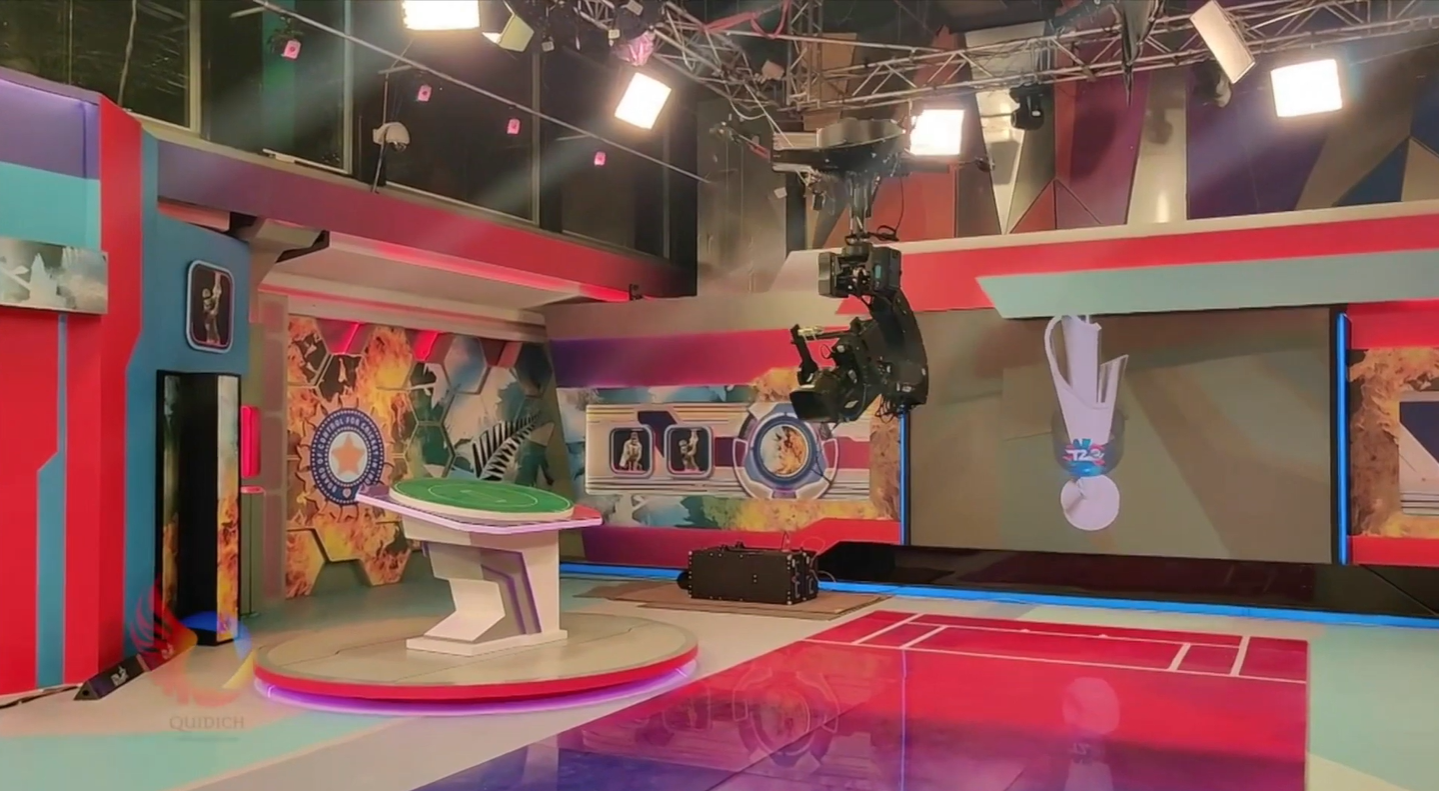
Article Scope
This article compares ceiling-mounted motion-control cranes and four-point 3D cable cam systems in practical studio terms: movement capability, rigging and adjustment time, interaction with lighting grids, and how ceiling height and cable sag affect usable flight volume. It is a decision guide for system selection and planning.
Crane or four-point system
For studio setups, one of the most common decisions is choosing between a motion control crane and a four-point system. They overlap in some capabilities, but the differences become clear once you look at how they behave in real environments.
Both systems can be installed from the ceiling, which is a major advantage in studios since it keeps the floor completely clear. In that sense, a ceiling-mounted crane and a four-point system are similar - neither interferes with ground operations.
The key difference is in motion. A four-point system delivers true 3D movement, allowing the camera to travel freely across the entire volume of the studio - from one corner to another - without meaningful restrictions. This opens up a very wide creative range. A motion control crane comes close to 3D, but not fully. It combines one axis along the rail with two axes on the arm, so while it covers most typical shots, certain movements remain limited.
That said, the crane has two very practical advantages. First, it is more cost-effective. Second, it is significantly faster to rig. With a rail-based setup, you’re typically working along a single truss line, which simplifies installation and allows the system to be lowered and adjusted quickly.
A four-point system requires more planning during rigging. Lighting grids can become an obstacle - not a blocker, but something that needs coordination. In practice, it’s always possible to install the system, but lighting teams often need to reposition fixtures to accommodate it.
Another important factor is ceiling height and studio dimensions. Four-point systems are limited by the sag, which affects the flying height. The larger the working area, the more cable sag you introduce, which reduces the maximum achievable height. In a wide studio with a relatively low ceiling - for example, 4 meters high with a 20-meter diagonal - the usable flying height can become quite restricted. In these cases, a crane has a clear advantage, since it is not affected by this limitation and can reach the full ceiling height anywhere in the studio.
Finally, in terms of flexibility, the four-point system stands out. The same system can be deployed in very small spaces or scaled up to cover something as large as half a stadium. So, if the goal is to use the equipment across multiple studios or venues, it provides a much broader range of applications.
Cable cam guides
Camera Crane vs 4-Point 3D Cable Cam System for Studios
Compare ceiling-mounted motion control cranes and four-point 3D cable cam systems for studios, including motion freedom, rigging, ceiling height, sag, cost, and flexibility.